


Eric Escoffier, Thierry, dialogue croisé

📚 Tous les liens utiles RGNR
Codes promo, boutiques partenaires, réseaux sociaux, ressources : retrouvez tous les liens importants sur liens.rgnr.tv.
Transcription de la vidéo
Transcription automatique, elle peut contenir des erreurs.
Lire la transcription
If there are no questions, I would like to make you notice something to start, which always amused me. You know, earlier I told you about the bacteria, bacteria that are on the surface of all the mucous membranes of the body and that make a protection service in a way, an immune system.
And I remember having discussed with Eric, we talked a little bit about the same role that bacteria have for the soil, that is to say that the assimilation in the soil is only done because there are bacteria on its surface.
Do you want to tell us a few words? These bacteria are microorganisms. Mushrooms are microorganisms. I love them. Globally, they are microorganisms that, around the roots of plants and trees, decompose the sea rock and make clay, which is the key to fertility, and release positive cations, which are essential for fertility.
There are other microorganisms that decompose what we call the litter, which are leaves and fallen branches, all the organic matter that makes what we call the humus. And there are other microorganisms that make this humus and its clay, which are two colloids, to be associated with each other in a stable way, by using cations to bind them, to make glue, let's say, electrostatic.
Without these microorganisms, there is no humus, there is no clay, there is no soil. The soil is a particle of humus, a particle of clay, of colloid. And if there are no microorganisms, rather mushrooms, there is no rhizosphere, which means that these mushrooms transfer moisture, It captures, it's networks, it's kilometers and kilometers of networks that these filamentary mushrooms have.
They capture the least humidity in the soil, in large quantities, and transfer it to the roots of the trees with nutrients in it. That's the first thing. Then there are microorganisms everywhere in the tissues of the plants that allow them to manufacture, especially for example with the mineral nitrogen that is in the soil, to make the proteins in the leaves, to make the nitrogen rise.
There are microorganisms at each stage. There are microorganisms that will, on the contrary, transform the humus, the fertility of the soil, into minerals, assimilated by the extracellular roots. So microorganisms are everywhere.
They are everywhere and they are absolutely necessary. Absolutely necessary. They are the ones that degrade everything that life produces, but transform it into fertility and allow life to take place.
And then there are all the microorganisms that make it so that we don't have any diseases in the ecosystem, that the vegetables are ok, and as you say, we have more microorganisms than cells in the digestive tract.
So that was a first parallel that seemed obvious to me. Are there any questions? Yes, so my first question is here. Great. So if you don't mind, if you have any questions, raise your hand high enough so that we can see you. Hello.
Hello. Yes, yes. My name is Caroline. We have already exchanged e-mails. And you were very kind to advise me about my diet. No, I don't give any advice.
I'm not qualified for it. So I didn't advise you, you're wrong. No, okay. It wasn't me. For not having advised me. That's it. I'm following the GAPS diet, but you told me that there should be some changes in relation to the GAPS diet, and I don't have a follow-up.
It's interesting what you're saying. She's talking about a diet called GAPS, which was developed by an English nutritionist. And overall, if you listen to my videos and then open the book, it's just the opposite.
Technically, it's just the opposite. And on top of that, the woman called Natasha Campbell, she has great results with autistic children and so on. So quickly, it makes you question yourself.
That's why when I was told about the work she was doing, I bought her book because I was told she had results. I said, well, let's take her book and see what it is exactly. And so, in fact, it's a diet in which, globally, it's... For me, it's banana and carrot.
For her, it's pork fat, butter, and egg yolk. And well cooked. But cooked, cooked, and cooked again, and cooked, cooked again.
As I was saying earlier, I think that the war of macronutrients, lipids, and glucose is vain. What is important is to have an enormous abundance of minerals, vitamins, and antioxidants, and then to have, at the level of macronutrients, lipids, and glucose, depending on the needs of the individual at that moment.
The problem is that we always think in a fixist way. We think that all our lives we will have exactly the same needs, of the same shape, and that we respond in the same way. And that, for me, is one of the big crossroads of human thought.
That's why I'm not in favor of a diet like, there are those who eat only sweet fruits. You have to eat sugar, sugar, sugar. If you don't eat sugar, you're not in shape. In practice, I know a lot of people, if you do that to them, it's the complete crash.
They're going to be eaten by cannabinoids, it's not going to work, they're going to be in complete acidosis. On the contrary, there are some who say, you shouldn't eat fruit, it's horrible, you should only eat fat.
In practice, there are some who do this, for a few months it will work, then after a few months they will have their stomach so full that nothing will work. In truth, it's not one or the other, it's fluctuations and regulations in real time, depending on what our needs are.
And the only way to know our needs is to finally enter a form of feeling, because otherwise there is nothing that can give it to us. There is no rule that can give it to us. The GAPS regime, its primary goal, was given to children who had autism problems.
I have an autism son. We know very well, I see exactly, to whom I have not given advice, we know very well that autism problems are purely and simply digestive problems.
It has nothing to do with the psychological that is extracted in the clouds. The goal of Natasha Campbell is to restore the intestinal ecosystem as quickly as possible. And for that she showed that you need little fiber, because the intestines are extremely inflamed. You need little fiber and a lot of fat.
So she uses a lot of fat, including saturated animal fats, cooked and cooked again. In practice, what I saw, because I was interested in it a lot, what I saw was that in theory it's very nice, but it's very unbearable, and very quickly it leads to an acidosis state, where it would be exhausted quite quickly, because there are too many animal products, and not enough plant products.
That's why I had proposed something that held the best of it, that is to say, OK, people who have extremely inflamed intestines, and who have pathologies related to the intestines, well, a lot, a lot, a lot of fat, including, why not, saturated animal fats, but rather raw Proteic portions are not important, so don't start eating meat on meat on meat both for ethical reasons and also for physiological reasons because the body is not adapted and above all,
think that fibers are not at all adapted at this time So what does it mean? It means consuming products either in cooked form to destroy the fibers or in juice form because that way we have all the micronutrients but don't start rooting carrots on carrots, because it's going to be extremely inflammatory So that's how we manage to have a kind of synthesis between a crudivore approach because it brings the maximum amount of micronutrients, and I think it would be a shame to do without it and an approach like Natasha Campbell's,
which says you need a maximum amount of fat Well yes, you need a maximum amount of fat, but why not go and look for it accompanied by micronutrients, and can be transformed by heat That was my synthesis, and in practice it works, it makes a lot of improvements Yes, I also live on lacto-fermented vegetables.
Everything that is lacto-fermented, for example, is a wonder, a real wonder. Everything that is lacto-fermented, everything that is loaded with enzymes, will participate in this.
These are children, we simply realized that autistic children, or the autistic spectrum, they have bacteria that others do not have, and these bacteria use food to produce neurotoxins that no one else has.
So it's just a matter of dysbiosis intestinal. They have bacteria that shouldn't be there. Most of the time, we showed that it wasn't strong. They are children who develop, in quotation marks, normally, if the norm makes sense.
And then one day, we give them antibiotics, and what happens? During the time we have antibiotics, for a month, a month and a half, two months, we have a kind of failure in our immune system, in our bacteria.
And at that moment, it's a bit of luck for the little ones. If there are extremely pathogenic bacteria in the environment, the child picks them up, puts them in the digestive tube, and that's it, it doesn't work properly anymore.
If that's not the case, he can go through without having any problems. That's why there are children who will take an antibiotic and won't have any problems afterwards, and others, yes, because it was a bad luck.
So it's about restoring the intestinal ecosystem. Everything that will promote this, bring a lot of friendly bacteria, will participate. But it's a real challenge, because it's a problem of the autistic spectrum. There is pure and hard autism, but there is a colossal amount of tangents in children today.
It's something I know firsthand and I've seen improvements in children who were classed as abnormal, to have a behavior, to find a behavior, a tranquility, a peace, just for children of their age.
It's just wonderful to see. Hello. I have a question for Eric. How do you see the evolution of the human demography on land and the reforestation, the reforestation, excuse me, the reforestation, because the other one takes up a lot of space, and each one has to find its own place, how to do it?
Okay, well, in fact, it's going to be done on its own. Agriculture consumes a lot of to produce our needs, because it is not productive. Conscious permaculture systems that include a lot of trees are up to 300 times more productive, which leaves even more room for reforestation.
The other thing is that we have forests that can both... I'm talking about forests that reforest, forests that feed, forests that produce forage, because we are not only here in France or in the rich countries.
The global challenge is the countries in the intertropical band. There, more important than the health or the food of humans, it's the animals, in some cases.
So, produce our food, produce deforestation, produce our food in the same forests and medicinal plants as the forests that reforest. So, in fact, today we have the impression that it is competitive to produce our needs, to satisfy our needs, air, water, good air, good water, good food, energy, building materials, materials to make clothes, that's what we need.
And then the social group, social harmony, social security, the security of the social group. But, in fact, it is not competitive, it is competitive because we no longer have forests. So let's put back forests, let's put back trees, and we're going to do it all at once.
And then I told you, when you produce 20 calories or 15 calories for an investment, it leaves room to make forests. So overall, it means that all the water, all that is water, the summits, all that is steep slopes, and all that is the edge of the aquatic zones, rivers, lakes, etc., must be forest, absolutely. Because that's where life, the earth as a living organism, is most in danger, that's where it's the most erosive,
that's where there's the most risk. But there's a lot more. Another thing, we have 40 million square kilometers of agricultural land that is no longer cultivated because the soils are degraded, dead, we can't do anything about it, in agriculture. But with soils like that, we know how to make forests that reforest, that produce food, that produce matter, energy, medicines, forages.
So we've only started on these 20 million square kilometers, half of 40 million square kilometers, that leaves room. In fact, there is no competition. We are colonized. We have been colonized for 10,000 years by the agricultural system.
So, our conditions. The poor farmers, they do agriculture. We teach them that. They don't know that they are doing a destruction business. And in the meantime, we haven't come up with enough to feed people.
So, we have to continue. We will have to make a transition. The farmers, we teach them all that. They don't know either. In short, we are in a system where we have the impression that we can't do both, but there is absolutely the place to do both.
And to think differently. Effective thinking. Stop thinking. We have to strive to gain our crust, to get our crust out of the ground in the proper sense. This is not true. This is a recent invention of humanity that dates back to barely 10,000 years. There is nothing 10,000 years in the history of humanity.
And what I also wanted to add is that despite our systems that are inefficient and pro-productive, we are already in overproduction. We are currently destroying stocks to artificially maintain market prices, to create a rarity.
So the rarity is purely created by man. For thousands of years. And with an agrarian method that is certainly not the most efficient. So with a much more efficient agrarian method that would take much less surface, I mean, we have a potential for evolution and we can push the accelerator, it's good, you can have children, let go. Regeneration is what we're talking about.
You have to imagine that life has spontaneously emerged. So there is a phenomenal power of life. Agriculture spends its time fighting against that. And to put the system in conditions where plants don't grow, and to fight against the system that wants to heal again, just like the body does.
It's the same. He went to Katibini, but it was exactly his goal. So we are exhausted. We are exhausted to fight against the wild life to produce what we need, while we harvest, orient, regenerate and let it grow.
Sometimes I say there is a little push to put at the very beginning, and then it's impressive at what speed systems start to produce. Two examples. What example? I talked a little bit about prairies.
Can I take two minutes? Yes, go ahead. We have an example, for example, which I think is quite speaking. We had, well, you know, Arizona.
So, I remind you, don't forget that before all this, everywhere before on the planet, we had forests, with a few exceptions, even if it's not yet well established.
So, here we are. We cleared these forests, and we end up with two types of situations. Or ecosystems that spontaneously go back to the forest if we remove human activities. It would be enough to remove agriculture and livestock and it would reforest.
That's the majority of cases. And so we could completely design permaculture systems because we have 20 million square kilometers that are useless. And then we remove human activities, we let the fields go back to the forest, because there is no competition.
And then there are cases where it's a little bit blocked in systems... What do you call those systems? Unstable balance. You know, unstable balance is this. So, imagine... It holds, a small psychonode, and it goes.
I'll give you an example. In Arizona, there are deserts that have been deserted since man deforested, and that have been blocked for decades, centuries, I don't know exactly. In parallel, I would take for example, that's why we often say that the body regenerates on its own.
No, sometimes there are desert states, that is to say that without a small chicken egg, the person, even if you simply feed it raw, it won't be enough, it won't restart, because the nervous system is completely exhausted.
you still need a minimum of resources. And these deserts, if there isn't a bit of human activity to revive them, but well-oriented, it doesn't move. Even if you leave it to itself, it doesn't move.
What's interesting is that it can be a very small input, a very small investment. So, the experience in such a desert, in the Desert of Death, Arizona, we put through a kind of big machine, a big machine like the Moschoneus Bates, a kind of big metal roller at the front, with a kind of V-shaped tool, which makes prints in the ground.
Imagine a kind of small trench in the ground, in the shape of a V, not very wide, maybe 30, 40, 50. We can't see it well because it's mostly a detail on a video, but not very high.
Once we passed this machine, we just made holes, something that was random. We made holes from time to time. And then we leave. And spontaneously, a meadow grows.
We didn't add seeds, we didn't add water. What happens? I didn't have time to talk about it, but one of the main principles of permaculture is to exploit the non-linearity of living systems.
I'll be brief. Living systems are non-linear, which means that sometimes a small cause can have huge consequences. Permacultures are specialized in cracking and using nonlinearities in living systems to optimize the process.
So we did this little thing. What happens is that in these little holes, there is always a little bit of wind, the finest particles will accumulate. The finest particles, by definition, are clay particles, the basis of fertility.
There is a big temperature difference between day and night in the desert. So there is humidity that will condense at night, because the temperature is very low at night, relative to the day. This humidity will be much better preserved in a small hollow than if it were flat. And then there is a little bit of snake mu, four spines, a little bit of organic matter that will come there, and then there are seeds.
And all this is brought by the air, by the wind, and it accumulates at the bottom. it is enough to cross a threshold of discontinuity, because of the non-linearity of the systems, and the seeds, with this little humidity, will germinate. And then, once we have a meadow, the experiment has stopped there, as far as I know, but once we have a meadow, there is nothing easier than to sow in there, to fly it,
even by plane, a mixture of a serious diversity of species, from herbaceous trees, spruce trees, the bristling evenings, the arbors, the pioneering trees, unable to withstand the full light, which is a minority.
And then we sow it once and it's over. The forest is gone and we will never have watered it. So that's an example. We did a little psychonaut. Otherwise, we remove human activities from the ecosystem. It goes back to the forest.
So let's do it while preserving our resources. Of course, our ability to produce our resources, permaculture allows it and we have no problem. I have an example of this. I come from the Eastern Plains. And luckily, we have removed all the vineyards.
The vineyard is one of the most polluting cultures on the planet. I'm happy about that. And instead of vineyards, what is growing now? It's growing yeasts, in large quantities.
And there are people in the area who are struggling to cut the yeasts. Because they say it's ugly. But yeasts are one of the stages of soil rehabilitation. That is, yeasts grow and it is within the shade of yeasts that things will be able to germinate. So it's a bit like symptomatic.
If we consider that the genet is the problem and we cut the genet, the soil will always be stuck in a state of desert and friction. On the other hand, if we let the genet take place, then there will be other trees that will germinate.
After a while, the genet will disappear, just like the branches disappear after a while. There are no branches in a sub-tree. The branches appear in open spaces. From the moment the trees grow, the branches disappear.
So cutting the branches permanently is preventing the process from happening, this process of return to balance. And more generally, you have to know that... I didn't go into detail, but I'll say one thing.
Photosynthesis, the ability of leaves to make tissue from plants, to grow plants, to make all our nutrients, because we eat leaves, fruits, roots, or animals that eat plants.
This photosynthesis, and it's a big mistake in agriculture, doesn't work properly with direct sunlight. We can see each other very well, but I'm not the sun, you're not the sun, and I can see you, we can see each other.
We work in reflected light. Photosynthesis works in reflected light. Look at the total surface of a tree leaf, if we do the cumulative sum, it's hundreds of hectares, for a common tree, has several hundred hectares of accumulated foliar surface.
On that, there is about one hundred thousandth which takes the direct sunlight. And these outer leaves, they don't work well. Photosynthesis is done with a shaded light, an indirect light.
That's the first thing. Barely 10 % of species are able to germinate and grow in full light, with direct sunlight. They are called pioneers. They are generally also able to grow on soils where there is no organic matter, where there is no fertility.
10 % of the hundreds of thousands of species that exist on the planet, it leaves room for the choice of pioneer species. And so, the pioneer rosaceae, of which you speak, Rhombus, Betpine, Glantier, Prunellier, are pioneers that only grow in an open environment, therefore in full light, and that will disappear when the environment closes, when the forest takes over.
the pioneering leguminous plants of our country, Coronie, Jeunet, Citiz, for example, etc, etc. And all our wild salads, all the bad herbs in agriculture are pioneers, almost always. And in agriculture, we spend so much time fighting against these things. Not to mention that they bring back... So, what do these pioneers do?
Whether it's acacia, or shrubs, We have pioneer trees, for example. All these pioneer species, their role is to create what we call the pioneer phase, to reconquer the environment from the open environment.
It can be a fire, it can be a field, it can be a lab, whatever you want. It will spontaneously return to the forest by a pioneer phase, based on pioneer species.
And this pioneer phase kills itself, in quotation marks, because it restores fertility in the soil, it replaces the litter, the mulch, and allows the microorganisms to live again.
I didn't say it earlier, the only condition for the microorganisms that produce soil fertility to be present is that they have a roof, so a litter, so that the soil is not bare.
And then, these species of light put shade in the ecosystem. And by putting shade, little by little, they de-favor their own germination, because they prefer to grow when there is more light, and on the other hand, they will favor, by closing the environment, a more and more dark environment that favours the non-pioneer species, the end species of the forest.
We call this the climax stage, the climatic species. An ecosystem will go from the pioneer stage to the less pioneering stage, then less pioneering, then more climatic, etc. We, permaculturers, will play with these keys, with light. What are the accelerator and the brake? Energy is the sun, it's photosynthesis. We will pilot light, That's piloting our gas controller, so that if we want to produce more climatic species, I want oak,
it's climatic, I want fruit trees, in general they are climatic, I want pioneers, I'll put less shade, but still a little bit of shade, more light, etc.
We're going to pilot that. And so all these pioneers consume... So there's the shade, there's the fertility, there's the imbalance of the soil, I'll finish with that.
There are the deficiencies of the soil, and then there are the constrictions of the soil. There are species, in the soils that are deficient in what you want, that will grow. So all the species that spontaneously grow somewhere are the species that consume the conditions of their domination in the system.
So they consume exactly either the excess of something, or they restore the deficiency of that something. So if we let the chardons, the rhumex, the iserons, everything you don't like, the chendans, and if we let the yeast do its job, they will disappear because they will rebalance the environment, like the decarences, detoxify, remove what is in excess, the fillings, whatever you want.
And little by little, we will move towards more and more balanced soils, less and less toxic, which will grow better vegetables, more and more nutritious and more fertile, and therefore more and more abundant in quality, quantity and diversity, including micronutrients. Because it's useless to grow tons of food in agriculture where there are no more oligoelements, no more minerals, no more vitamins, no more catalysts for metabolism.
We can have everything we want if the reactions are not catalyzed. It's useless. So that's micronutrients. If we don't have microorganisms, if we don't have fertility in the soil, we won't have them.
I have another question here. I wanted to ask a question about vegetable fat, in particular coconut oil. and I also wanted to know what was in France in relation to these things. Were there other oils, other coconut oils?
Because I know the disaster of palm oil and I have to say I thank you very much for this conference because the mixture of Thierry and Escoffier I think it's a good marriage. Your question Jean is, are there alternatives to coconut oil and palm oil? That's exactly what I'm interested in, because I know that, especially for people who have digestion problems, I know that coconut fat is extremely interesting to balance and perhaps also avoid animal fats.
So, I'm going to take it from a physiological point of view. Eric, you answer from a biological point of view. From a physiological point of view, apart from breast milk, there is no fat similar to coconut oil.
It's what we call medium-grain fats, so they are ultra-digestive, they don't require bile, no digestive enzymes, no lipase to be digested, so it's ultra-digestive.
Coconut oil really has particularities that make it really unique, which should also make sure that we keep it for use, for people who really need it. but we also know that for everything that is neuro-regenerative, for example at the level of the brain, coconut oil has virtues that no other can match.
It's clear, it's unfortunate. Indeed, I imagine that the coconut culture, if it becomes like the palm oil culture, it will become an ecological disaster in these countries. So it's not a solution. Do we have something, I don't think, that is equivalent?
So, I'm going to answer from above. First of all, you have to look if among the hundreds of species of palm trees that exist, other than the species of palm tree that we call cocotier, there are some that would have similar lipids.
We'll see, I don't know. That's the first thing. Secondly, before I forget, if it's tropical, you can absolutely cultivate cocotiers It's in the middle of a forest, producing everything we want at the same time.
So it's not a problem. Where are the... For this category of lipids, I don't know. But where are the lipids on the planet? They are in two places only.
No, three places. In animals, we know that. And in plants, it's either in the seeds when they are edible, or in the flesh of certain fruits, such as olives, avocados, kiwi, figs, and things like that.
In our country, there are only a few tonnes of fruits with oleaginous flesh. We have seeds, however, we have a diversity of seeds. Almonds, hazelnuts, xanthoceroses, pecans, pistachios, pine nuts, all that makes protein and oleaginous.
and seeds of other species as well. I only took the trees, because I prefer to take the perennial species, it's much more productive. And I imagine that if everything goes well, if the ecosystem is OK, and if we eat properly for a while, we don't need this quantity of this particular lipid. What we need to see is that an organism that functions properly is characterized by, for example, For example, a person's capacity to eat for a certain period of time is important.
The more exhausted a person is, the less capacity they have to eat. They eat very regularly. Why? Because they are subject to what we call hypoglycemia. It's a purely hormonal reason. Some hormones are missing, including cortisol, which means that the person can't take advantage of these resources.
Sometimes we even come across paradoxes. These are people who are plethoric, who are overweight, but since they are exhausted, they don't have the hormones that allow them to take part of their fat mass.
And so they are always hungry, even though they already have reserves. But this, the characteristic of a person who has his intestinal system, his digestive system, his complete body system, which would be rehabilitated, is that it can go on for a long time without having food.
And in the same way, it can substitute one food for another. That is, normally the human body has a colossal capacity for adaptation. This is done physiologically speaking, with the liver, for example, which is the great transformer of the system, it takes nutrients and transforms them into other things.
There is even a scientist called Louis Kervan who showed that we could really make food sources of class. It's called biological transmutation and he shows that from sugar we could synthesize proteins if the liver works properly.
So the adaptive capacity of the human body is colossal and it's reassuring because the human has been in an environment that was not always exactly in response to his needs. This is very modern, to have access to a permanent diversity throughout the year.
Humans existed before refrigerators, before supermarkets, and at that time, they had to function with what their environment gave them. So there is an adaptive ability of the body, yes, provided that the nervous system, the hormonal system, and the digestive system function properly.
So, for me, coconut oil is a good alternative, but you also have to learn how to get by after a while. Maybe we should reserve it for people for whom it is really important, if it is a matter of supply.
Everything that is neurodegenerative, for example Parkinson's, Alzheimer's, and so on, the number of studies on the efficiency of coconut oil to recreate neurons in this area, it is amazing.
So it is something essential. And then, well, there is diversity and the quality of the ecosystem including the nutritional quality of vegetables. And with the only ones we have in agriculture today, Today, even in bio, our nutrients are scarce, they don't have the nutrients.
I would like to know what it gives, in terms of capacity to create phospholipids in the body, someone who would eat a diet where there is again phosphorus that is unblocked in the soil, and not scarce or blocked, things like that.
So the nutrients are no longer there. So inevitably we work badly and maybe afterwards we depend on coconut oil. We have an extremely fragile vision of the human body. In other words, compared to our current experience, we are experimenting with human bodies that have an extremely limited adaptive capacity, that are very, very sensitive, that get out of control at the slightest mistake.
But that is not the reality of the human body. That is, the human body is really an organ, a system, let's say, of a colossal adaptation. Except that there is no access. The priority is to have access.
And for me, one of the keys to access this human body's capacity is, above all, the strength of the nervous system. I don't deny that. That's why, for me, the first disease is exhaustion and stress.
That's clear. And that's the characteristic of our time. That's why we're going so badly. It's because we don't have time for rest, for holidays, for freedom. We have programs that are very, very busy. I don't want to brag about the children, but for me, that's where the first degeneracy begins.
These children that we take care of from 8 a.m. to 8 p.m. with impossible rhythms. It's totally normal. I mean, we already destroy nervous systems from an early age.
I'm not a conspiracy theorist, but I sometimes wonder if it's not by design. It's normal. If we break the nervous system of an individual, it's okay to just swim like that, to swim the arm and then breathe on the surface.
But in terms of initiative, of energy, of creativity, of capacity also to question existing structures, to renew them, to improve them, because we always talk about overthrowing existing structures, but in creation, we go from one step to another.
It's a normal system. Stagnation is something completely abnormal. Having structures that last forever is completely abnormal. So for me, the exhaustion of these nervous systems linked to the delirium of work and the rhythms that are imposed on us and to the stress induced by human relations, individualization, mobile phone rings and all electromagnetic radiation, all of this is one of the primary causes of exhaustion and the inability of human beings to regenerate properly.
J'ai quelqu'un qui voulait rebondir sur ce que vous disiez. Bonjour. Oui, donc dernièrement j'ai vu le médecin du travail. Donc il me connaît bien et puis il m'a demandé comment ça va depuis la dernière fois qu'on s'est vus.
Alors je lui ai raconté l'expérience du vivre cru. Ah, il me dit oui, j'en ai entendu parler. Mais bon, ça peut être dangereux It's dangerous because... Do you use oils?
So I said, no, I don't eat oil. She said, but it's very dangerous because your intestine is not lubricated. At least, if you don't want to get fat, you have to take paraffin oil.
So, fortunately, I didn't listen to her too much. And then, when I went to see my hygienist in the colon, I talked to her. she said to me, don't do it, it's the worst poison, because it's an oil that degrades very slowly and it can take years to get out of your body. And so it made me go back, when I was 15, when I already had weight problems, I was given a diet based on paraffin oil.
So my question is to know how to get out of that, I don't know what to do with this oil that has been in my body for a long time. To get rid of the paraffin oil? Yes, and all the problems I have with the colon. I had a very big problem with the colon.
Can it come from there? Why not? I don't know. It's certainly possible. Well, paraffin oil is not edible. If you swallow petrol, of course, it won't work as well.
Well, here it's a bit the same. So, after, everything cleanses. Everything cleanses in the body. Frankly, when I see what can be rebuilt, when I see what can be cleaned, the thing I think about, because you also talk about weight gain, and diet, I would like to say a few words, because there is a belief that is completely wrong. most of the time, we think we have to go on a diet to lose weight and to be in good health.
It's just a great nonsense, it's just the opposite. You have to be in good health to lose weight naturally and find a suitable weight. So we think you have to lose weight to be in good health, you have to be in good health to lose weight.
It's just the opposite. And that's why I tell people, normally in the body, overweight is not possible. There is a whole system of hormones that regulates weight The human body is not made in any way We are not going to inflate and inflate in an unmeasured way There is a system of hormones that regulates the weight gain If it doesn't work, most of the time we have shown that it is because there is a global inflammatory state in the body That's what we have to target, rather than trying to constrain ourselves
Because anyway, if we constrain ourselves, there are other hormones that will make our appetite double So we are going to hold on to the mental for a certain time and then we'll let go and gain twice as much weight. The more the hormones that have been released, the more hypersensitive the receptors of these hormones are, which means that we'll have an appetite that will be doubled in relation to that.
So weight loss is the huge scam of our civilization. We think it's a matter of will, we think it's a matter of quantity, but it's neither a matter of will nor a matter of quantity. It's a matter of choice, of quality, quality of product.
and as soon as we make adequate choices, that is, we reduce the body's inflammation, we get back into a healthy state, at that moment the body's weight is regulated in an adequate way. Then, for all the stagnation of matter in the intestines, there is no other choice anyway, technically, there is no other way than to trust the body to clean itself.
That's just it. It would be a lie to say the rest. So, you're going to have products, medicinal plants that can help to sweep and so on, it's going to participate, but in the end, I like to quote this quote from a doctor called Ambroise Paré, who I find to be of incredible finesse, and who was doing well in his place.
And yet Ambroise Paré, he was a great doctor of the time, a very great one. And he said, I heal and God heals. So whether you are a believer or not, it doesn't matter, you say, I heal and the body heals.
In healing, we just have a role to give the right conditions for it to happen. But is it going to happen? Is it not going to happen? It doesn't depend on us. We don't control everything.
And I think it's really something that we need to be able to anchor in the brain. We don't have all the data. All we can do is give the right conditions. So we have to study these conditions, know them, give them, so bring care.
And I think it's fabulous to be caring. I think it's one of the most beautiful functions of humans. On the other hand, we are not healers, we are caring.
And once we have given these good conditions, well, there is not much more to do, we have to wait. And if it doesn't come, you really have to check if all the conditions have been met, see if there is not one thing or two that could be added in terms of good conditions, but wait, wait until it happens.
And sometimes there are a lot of processes that we don't see, that we don't know, and yet they are put in place, and they will make sure that all of a sudden, it will restart.
I'm talking about my experience, but frankly, for those who know my story, I fell very, very low about 8 years ago. When I started videos, I wasn't very fresh, even though I had been eating raw for 4 years.
I was alive. Compared to the state I was in at the beginning, I was much more viable, but I wasn't fragile. The first videos, you run away when you see them.
Now, even when I see them, I get scared. It's real, it's real. And then, all of a sudden, what happened? In April of last May, In 6 months, I gained about 15 kilos.
I didn't take any testosterone, I didn't take anything at all. It was done, it started because it was ready. What happened afterwards, I don't know.
I can't say I rested more, on the contrary, I worked even more than usual. So I wasn't more rested, no, it was done. It was ready, it was done.
But I knew, every time I was bothered with my weight, for example, I said, I do what I have to do for it to restart. So now I'm going to wait for it to restart. I can't do anything else.
I didn't start drinking oil from the bottle. It won't change anything. It's going to charge my liver. I do what I have to do. I eat enough. I'm in good condition.
It's going to restart. So, in terms of weight loss, in terms of cleaning and everything, there's a dimension, which is everywhere. When I use this word, sometimes it makes me shudder.
There's a dimension of faith in there. Knowing that what we do is good and taking care of other things. It's like when you plant a tree. You plant your tree. You put it in your hole.
Ideally, it's to sow a core. You sow a tree. You sow your core. You're going to make sure it gets enough water. So you're going to check the wells to make sure it got enough water this year.
You're going to make sure there's a good ground cover, a good mulch, so that it doesn't dehydrate. And then what are you going to do? You're not going to spend your days looking at the hole and saying, what's he doing?
He's not coming out, he's not coming out, he's not coming out. Sometimes it takes two years, three years. I threw seeds three years ago, and all of a sudden they come out.
Why did they take three years? Because the conditions are now established. So we're not going to spend our time looking at the seed. We know we've given the right conditions. We come back regularly to check that we haven't forgotten something, that there's not an animal that dug into the hole and stung the seed.
Well, because that would have to be remedied. But once it's done, it's done, and we let it be done. But to do that, you need to know the right conditions for the seed to germinate.
Including the conditions for such a species to sleep, which can be different from another, etc. But in parallel, there is the reality. When you do what you need to do, you give the correct conditions, you have to realize that most of the time, it works. The seed germinates and the tree grows without us doing anything.
Because we respected the laws for this species. We lost a part of the wonder. To see a seed germinate, I always think it's a miracle. It's a bit like when I say the beta thing, you cut yourself with a knife and then your wound heals.
It's normal. A guy, his wound doesn't heal very well. But wait, it's just incredible. It could stay bleeding all my life. Why is it being reconstructed at this level? It's good that there is tissue reconstruction, and I'm not doing it for nothing.
It's not by planting my eye in my scar that it will be repaired. It's not by doing invocations. On the other hand, it's certain that if every day, when I was little, I did that, if every day I scratched the scab, you know, I scratched the scab, and they yelled at me, they told me, no, but if you do that, it won't heal.
Well, it's normal. I came to scratch the scab. Well, it started to bleed again. But I cried a lot, and they told me, no, you shouldn't scratch yourself.
So they put a bandage on me and I took it off. I didn't respect the process, but if I respect the process, it's done, I'm there for nothing, it's wonderful. It's wonderful for the seed, it's wonderful for the forest.
We imagine it for the seed, we don't imagine it for the bark of the forest. For the body, it's the same. We imagine it for the knife that will cut the skin. We say, that's normal. Come on, the liver, rigorously, it can grow back.
Die, the rest, it's good. That's why we often say, well, Thierry, does it grow back? Why not? Why not? Why not? And then prove it. If no one has done it, prove it. However, if our food is deficient, for example, there are conditions.
If you don't sleep, it's clear that the nervous system, to repair itself, you have to sleep. Sorry? The nutrients that are missing in the food. Exactly.
If you only eat food that is grown in hydroponics, on soils that don't have minerals. Even in agriculture. They are deficient. Even in organic agriculture. Agriculture is in progress, we can't do anything about it, there's no cover for the soil.
Hello, I have two questions, normally it's for Thierry, if all goes well. In fact, it's to come back to the GAPS regime, to know the differences, similarities, all that, with the cetogenic regime, and if you draw the same conclusions.
Then the second question is about a raw regime, if you don't have the possibility to have an extractor if materially it's not possible, or if in nature there's not necessarily an extractor but is it still possible ? Are there other solutions or not ?
So those are the two questions. And Eric, if you can find an advantage to today's agriculture, it's not bad. Thank you. He's going to concentrate for two minutes, he's going to find something. So, you ask the question, what are the similarities, that was your first question, and the differences between the GAPS regime and the raw regime?
No, cetogen. Cetogenic regime is a regime in which there is no sugar, no sugar at all, there are only fat bodies. And the goal is to produce what we call cetonic bodies that feed the cell and that allow to feed the brain in a certain way.
So, I will tell you by experience, this is where I came from. After years of self-gurutization, me too, to clean the internet, to see all the regimes, I tried everything.
I tried the ketogenic diet, I came to the conclusion that any diet that excludes a quantity of nutrients, that excludes lipids, that excludes sugars, that totally excludes proteins, in a punctual way it can work with a purpose, but in a regular way it doesn't work, because it requires an effort of adaptation to the organism that is strongly impactful. For example, imagine a guy who is full of candida albicans or bacteria in his intestines.
For a few days, for a few months, he has a real interest in stopping sugar completely. At the same time, he will take plants that will be a little bit antifungal. It allows to give a good hit to the bacteria.
Except that what we realize is that it creates stress in the body. Because if he doesn't have sugar, he has to turn fat into sugar. If it doesn't have fat, it has to turn sugar into fat and vice versa.
And all of this creates stress on the body. So, what we have to see is that every time we change our diet, particularly, there is always a phase, a small phase of honeymoon. And usually, traditionally, it's the moment when we create an internet site, open a YouTube channel, create a business around this diet, and then after 6 or 7 months, we are a bit stuck in our practice and we can't go backwards So, what I know about the ketogenic diet is that it is extremely popular In the US,
it is very popular especially for athletes The ketogenic diet is very, very, very heavily impacting on the liver and the consequences in a few months are bad and the consequences in a few years are very heavy on the liver So I can't recommend something like that However, in a punctual way What does punctual mean?
What does it mean? It means a few days, a few weeks, a few months, depending on the person, a few years even.
But this is also something that I would like us to get attached to. Particularly when we talk about a diet, but even when we talk about living conditions. We do something for a year, for two years, for five years, for ten years, but what allows us to say with such assurance, such arrogance, often, I will do this all my life, I will be like this all my life, and it will correspond to me all my life, we don't know we don't know anything
because the conditions around us and inside us change all the time for me, an excluant regime, too excluant, I don't think it works I don't think it works as a regime for everyone however, punctually, it can work the cetogenic regime, indeed for everything that is also neurodegenerative we have seen that having a lot more cetonic bodies at the level of the food of neurons, it works well so that's objective Did that answer your question?
Yes, yes. And what was the second one? If you don't have the possibility to have a juice extractor, for example, when you're on a raw diet, isn't that impossible? No, no. The only thing is, for me, the extractor...
You know, at the beginning, my thing was, extractors, as long as I wouldn't see them in a forest, I wouldn't take them. That was the thing.
So, since I rarely saw them, I was calm, I didn't take them. After that, I realized my mistake. It seems to me that one of the difficulties in our regimes is that we don't have enough minerals, particularly. Particularly also because the vegetables that we consume, often because they were grown in not quite correct ways, in soils that are poor, are very weakly concentrated in minerals.
Juice extractors seemed to me an interesting alternative to have a higher micronutrient intake and in practice, for a lot of people, it makes a difference. It doesn't mean it's essential, at all. In practice, what I've seen is that it depends on the constitution.
If the person has an extremely weak constitution with assimilation defects, if they have inflamed intestines, because usually it goes hand in hand, at that point, I think it's a pretty essential help.
If the person has a very good vitality, it already has a good mineral reserve and so on, it can do without without any difficulty. So it's an advantage, it's an advantage for people who have big intestinal inflammations, rectocolites, hemorrhages, things like that, it's an advantage that is essential for them.
Because you put a vegetable in their throat, it creates, they wrinkle in pain for weeks. At the same time, they need these raw vegetables because they are the only ones that will bring the minerals that will allow to deflame the mucous membrane. So we find ourselves in a kind of paradox, At the same time, they need raw vegetables, and at the same time, they can't stand them.
Well, with extractors, it allows you to squeeze all that. But, on the other hand, there are a lot of people who can do without it. If you want, there are some for whom it is essential, there are some for whom it will be an extra comfort, but not essential.
Okay, thank you. And Eric, can you save the agriculture? No, no. You're going to tell me, I might be saying something stupid, but even the cases you're talking about, If I don't have an extractor and I have what you're saying, it's going to be a fast.
I'm going to cut all the food into micro-organisms. You can fast for three weeks a month. I've been fasting for three weeks without any problems. Then my vegetables will go down to a low dose. And then I'm going to make the juice in my mouth.
So if you're in a condition where you don't have an extractor, you're going to get by. You just have to make the neurons work. We can do that. It would be wrong to say otherwise.
But it's more difficult. It requires more energy if you don't use it. Extractors will help. It's a bit like the vicious circle. For me, the weaker an organism is, the more it will require artificial external support to restart.
It's a bit like the shikonode we're going to give at the start. That's why people often tell me, when they look at me from the Guggenheim, that they don't need an extractor of juice, I don't judge you by all these artifices, but I say, yes, but Coco, look, you weigh 80 kilos, you run a marathon every day, you do climbing, your grandmother lived up to 120 years, I mean, you have a genetic that is not possible.
You can be arrogant, you have the means to be arrogant. But then, I often get up against this sentence, we often say, when we want, we can, and I'm used to reversing it, I say, when we can, we want, and we forget it too much.
The will, the will, if you're exhausted, you have a nervous system, you have intestines who are shot and so on. Eric just mentioned the fast, someone who is completely exhausted chronically, you don't make him fast, because he will completely go crazy, but that's the limit.
On the other hand, someone who has a relatively balanced or more or less correct organism, well, it's going to be great the fast. So it's always in finesse. So there are people who say, well, if the extractors, it doesn't exist.
Okay, but for some people For some it's vital, for others it's not. So it's about having the knowledge that also allows us to wish that the other, despite his difficulties, can get there.
It's a bit like my speech. And it's the same at the transition speed level. There are people who say I jumped from one day to the next in the raw and it went really well. I don't understand. Me too. And I don't understand him.
He takes time. Or my spouse, as soon as she eats a little raw, she says to me, I have gout, she doesn't want to make an effort, she doesn't give herself the means, and then she only has what she deserves, etc. But you have to understand that we don't have the same constitutions, and in couples, sometimes it's a bit of a rock'n'roll.
So, it's up to everyone. The important thing is to know the right conditions and to do it in the smartest way. Because for me, you have to be effective first of all. And sometimes we waste too much time trying to refuse an artifice, under the pretext that we have entered a form of integrity, sometimes it's useless, so it's not worth wasting time with that, you have to find the right dose.
I have no argument for agriculture, I don't know what to say. It doesn't matter because I have someone who wants to ask a question too. Thank you. I have a question for Eric. I thought I understood earlier that you said that the underground mushrooms helped to humidify the tree that grows.
And if I understood correctly, what can you say today about these intensive truffing farms, which of course, there are underground mushrooms, but it creates a fire all around the tree, and in fact a lot of people complain about watering or not watering.
I think it's true that all this is a bit artificial. Can you give me some advice on how not to do anything stupid? Thank you. I'll try. So, mushrooms and microorganisms in general transfer water and minerals to the roots of plants.
That's clear. For them to live, there has to be a cover on the ground. Even thin. In the tropics, you can have a sheet or a few millimetres thick of litter. A sheet is enough to keep microorganisms alive underneath. You just need a roof.
I'm not a fan of truffles at all, but to my knowledge, I'm still from the Var, to my knowledge, the burn is a symptom that indicates that there is a potential for truffles.
I think, in particular, that there must be, to put it in a global way, a change in the proportion between bacteria, certain types of microorganisms, and others, particularly bacteria and fungi.
I think there will be fewer bacteria, and that will help the fungi to grow. Because all this takes up space, the ecological niche or the biological functions. If you have too many bacteria, you'll have fewer mushrooms.
So I don't see the point in watering. Burning isn't the consequence. There's something I didn't understand in the question. The microphone is gone, right? No, but the fact that a certain number of farmers decide that it is necessary to water, especially in the summer, to give the stress they say.
So, precisely, is it a bit incompatible with permaculture or does it diverge a little bit? So, there I can not answer at all. There is nothing incompatible with permaculture. with permaculture, there is a transition.
The guy who makes a living by selling truffles and continues to sell truffles, it doesn't prevent him from making a transition where he might start producing something else so that he stops buying all his food and doesn't just produce truffles.
But the idea... Do you have to water it at some point in the summer or not to produce a monoculture of truffles? I don't know. I would bet more on a certain diversity of species in the ecosystem.
But I don't know the whole story. Each species has its own conditions. I'll give you another example. I had some super pioneers that I wanted to have at home because I consume them and I find them very good.
Like, I don't know, the Tenture Pastel or I don't know what. I didn't have them at home. I didn't have a kinopod at home because I needed other conditions. And it was enough for a tractopel to improve the path, scrape the soil and bring the earth, and then it emerged.
So there are conditions for each species. Sometimes no, sometimes yes. So I don't know the conditions of truffles exactly. Thank you. I can't say more. After all, it may not be an aberrant transition to water a lot.
If by watering a little more we triple the production of truffles And with that money, we take advantage of it to create a sustainable, coherent, resilient system where we produce all our food locally. And we can live in an eco-village, in a group.
We can still grow truffles. I'm here, hello. It was a question for Thierry about regeneration. I have a varicea that has been here for 20 years. I've been making juices almost daily for 5 years now and I wanted to know if the vein could resume its original function and the valves could start working again because there has been a deformation, of course, for 20 years so I wanted to know if there is a possibility of regeneration of a vein and if we don't have to remove it and wait for it to come back, in quotes, but healthier I've already seen it.
I have testimonies. By the way, on Livre d'Or, I think you can find one or two. I saw at least one person who said she had two varices that had completely disappeared.
So, without intervention. So, it's possible. After, is it going to happen for you? I don't know, because you have to see all the conditions. But it's technically possible.
Yes. By the way, it seems normal to me that it's technically possible. It doesn't surprise me. Yes, I have another question here. Thierry, Eric, thank you for being here. I understood that you came to see us in Toulouse for the first time.
Thank you. I have some questions about permaculture on a time and volume scale. When we look at Thierry's website with the raw food videos, we see the juice extractor, the juices, we manage to understand, we apply it to ourselves, we may sometimes have difficulties to find the right products, but we create things and then we quickly see the effects.
I just arrived in the Toulouse region and I have friends, there are colleagues. If we want to have trees, if we want to sow trees, what is the idea of the scale to have the time scale?
So it will of course depend on each land, but we can easily imagine that a square meter of permaculture is not obvious. And 1,000 hectares of permaculture is perhaps a lot. If we want to be an actor, as we are when we drink juices, as we are today in this meeting, if we want to be an actor in permaculture beyond the internships, how does it work and what can we see, observe, that can exist in the region or elsewhere, that works and that would give us great ideas?
There are a lot of things to say, so it's not going to be easy. Space and time. One thing I can already say, for time, there is a fundamental factor, which is very misunderstood in general.
Vegetal dynamics can vary from very slow to very fast. And the number one factor that impacts this is whether there is a season of vegetation. So what does it mean, what we technically call a season of vegetation?
It is a season, or several in the year, in which you have conjunction of heat and humidity in your ecosystem. People who know the Mediterranean climate know that it does not exist.
There is no such thing as a dry climate in the Mediterranean. For example, in my home, in the center of Var, I will have humidity in winter and heat in summer. And I haven't had a drop of water since spring from March to October, for example. So these are the most difficult climates that exist because you don't have a conjunction.
So you have your window in the year of humidity from January to December, your window in the year of heat above 13 degrees, And is there an intersection between the two? In deserts, in general, I'm not talking about deserts with extreme latitudes, where it doesn't rain, precipitation always falls in the form of rain or snow, but in most deserts, Sahel, sub-Sahel, tropical with long dry seasons, or in India, where the fog falls over 15 days, and the rest of the year it's dry,
The little water there is, when it falls, it's hot. And you have this conjunction. And this is an exceptional dynamic. And this can be 10 years of loss on your tree growth, for example.
So you see, in my case, in the conditions I'm in, if I had watered my trees once a week, for example, or if I had a storm every 10, 15 days, as there was before, for example, I would have gone 10 years to get to 4 meters, for example, on the trees, or 3 meters, or fruit planting.
This is to give you an idea of the time. This is one of the criteria. For space, 1,000 hectares, once again, plant dynamics will greatly affect the number of people we can feed per hectare.
This is something that varies between a few dozen in the most difficult climates, to 100, or even more, in very favourable climates, where there is a long convergence of humidity, especially in the tropics.
So in terms of space, if you have 1,000 hectares, it's already a nice eco-village. You may have 10,000 people living on it, 50,000 people living on it.
It's not necessary. So here we come to a question, after that it depends on the 1,000 hectares, because if you have 1,000 hectares, you have a mountain like that, be careful, the slopes are steep, it must be forested, We don't do anything on slopes.
We don't put animals on slopes, for example. It's difficult to use steep slopes, for example. But if you have 1,000 hectares that are quite easy to use, that's a lot. So now it becomes land development.
We're going to take advantage of it to do something much more important, on a much larger scale. One square meter, I refer you to what is called urban permaculture, which developed a little later than the original permaculture. but it's been going on for at least 10 or 15 years.
And we have examples where we can produce a lot in the city. So here too, permaculture addresses the problem with its, I would say, decomplexed, emotionless and ideological perspective.
We have a city, what are the advantages and disadvantages? In a city, we have a lot of water capture, because we have a roof that goes up. We can easily store water.
We have a lot of vertical surface. We'll be able to grow lots of vines. But we have a temperate environment, because there's a lot of thermal energy. But we lack carbon, so we have to grow plants, sow agogo, etc.
And of course, we have to make it as dense as possible. Now we have designs, or on a square meter, using verticality, we can make it denser and denser, even more than we could do in a normal garden.
We're going to cultivate on roofs, we're going to become masters in the art of manufacturing soil at high speed. We have examples. Havana, well, there's the story of Cuba, which found itself brutally cut off from its imports, especially oil, and which in a few years managed to become the only country on the planet that is self-sufficient in food, in energy, without oil, with very high levels of development among the best countries on the planet, in terms of access to roads,
access to food, access to education, university level, mortality, infantile, etc. Among the countries with the highest level in terms of development index, autonomous without oil, autonomous energetically, autonomous in terms of food, and with an ecological footprint of less than 1. But what happened?
They were forced to do it. They were cut off from the supply of oil. It was the oil-sugar agreement with Moscow. They were cut off from the supply of oil because the situation didn't allow it. And without oil, they had to switch to something else.
Well, they switched to something else. They succeeded because they had a technicality. They knew the organic matter very well. They had kept a good technicality. They had kept 20 % of the activity in food production, whereas we produce almost nothing.
and then, well, they got there. But Havana today is a large metropolitan area, self-sufficient. Tomorrow, if we cut oil and uranium, because we don't have any, it's certain that it's not our big French cities that will be able to get by like Havana or Cuba.
So that's why there's a... I have two little things to add. There's an idea of transition. So the transition is to say, what means do we use to gain how much time to achieve this result?
There is this idea of what we call the impossible triangle. It's good, fast, free. In general, we can't have all three at the same time. So I'm going to say, OK, I put a little more, it's less free.
Free means money, because money is oil, it's labor. I can still use oil for a while to create the means to get by, no problem. So, do I put more input, more energy, or do I put less to earn 10 or 20 years?
So, if I put a little more work, I spend 5,000 euros, I earn 10 years, it works. If I need an army of oil or workers to earn a year or two, it doesn't work.
But the only honest answer is that it depends. It depends on the place, the physical conditions, the physical geography, and on the group, the human geography.
So there is this notion of transition. I don't know what else to say. Did that answer your question? Yes, it was the idea of knowing what we, We all live somewhere in the region, what can we do, what concretely can we do?
We understood with Thierry that we can change our diet, individualize it according to... Not only. That's the way of life. Well, a whole bunch of things, indeed. Yes, not just food.
Very good. But, as a result, this food, not only that, we will also need things to eat, that we can produce in permaculture. How does it work, concretely, if you want to be an actor?
So, there is what we called the transition movement. So, in 2006, in the south of England, in a city called Totnes, there was a Permaculture Design Certificate, or course, a Permaculture design course, which is the official international course, Permaculture for two weeks, which was given.
And at the end of the course, the teacher, who was called Rob Hopkins, with his trainees, his students, we said, we're going to do something to start permaculture in our city.
And that was the beginning of a historical movement which was called at the beginning, The manual of the transition is translated into French. It's Rob Hopkins who wrote it. It's translated into French. That's where it is.
And now we have transition initiatives, because there are not only cities in transition. Transition is the idea of saying, we leave here and now, wherever we are, it can be in the city, it can be in my neighborhood, it can be in my building, it can be in my ecovillage.
And then, what can we do? And permaculture really distinguishes between a period of 0 and 15 years. In difficult climates, it's 15 years. In easier climates, it's 5 or 7 years.
Or the ecosystem still doesn't have the productivity it should have. And when it's mature, it's hyper-productive, sustainable, resilient, etc. So what do we do in France? Well, in France, we do what we can.
Because there are constraints. There are law constraints. There's the SAFER, there's access to civil servants, which is extremely difficult in France. There's legislation that bothers us on many levels. on all levels, we still do it, we go around the problems, we cheat, we hide and we try to set up groups.
In general, we are now entering what is now called social and human permaculture and what we call design, in the sense of the conception of the community, that is to say of the social group. And there, indeed, there are things to know, things not to do, which mean that 90 % of the collective alternative projects of groups fail in a few weeks or and there are things, 90 % in France it's even more, it's huge, and there are things that absolutely need to be done.
And so it exists in permaculture. In the PDC, the famous two-week course, we talk about social and human permaculture, and the design of the group. And then there are masterclasses, and there we are going to be given the fundamental elements. Earlier I talked about the 10 keys to regenerative systems.
There are keys for the human system to work. Because if the human system doesn't work, the physical system won't work. And upstream, if we ask ourselves, first the group or first the place, it's rather first the group.
If we don't have a good design, in the sense of English, conception, organization, planning, of the group, it won't go on the ground. And so there are things to learn, things to know, so that the group works, even if each individual is not at the top, even if we haven't become a Zen master, where we don't manage our emotional problems, our ideologies, our emotions, we are full of conflicts and beliefs, we manage, by working on the design of the group,
with methods and tools, to get around the problems inside each of our heads. We are a bunch of idiots who get together and then... But no, if we have the right tools, we manage to make the group work effectively.
So that's what we learn, It's one of the things that permaculture teaches us. There are tools. Thank you. It's... Yes, 2,000 square meters, but even...
Listen, we have examples. That's enough. The problem is, one, it's going to be the skill. You still have to train. And of course, being alone is always much more difficult.
Because of the synergies, the skills, the motivation. But yes, we do a lot of things on 2,000 m². We can feed, I don't know, 10 people, 5 people.
We have extremely productive examples on 2,000 m². In any case, we can, and therefore we must, if we make the choice to get out of the system of the choice of death, of this planet that makes minerals and that makes fire, if we make the choice of life, we will do things on 2,000 square meters. And then there are things that you won't be able to do because it will depend on others.
You can't have an impact on what the other person who has 2,000 square meters will do or not. But you do your best, train yourself. And then I think you can find... You can lead the collective quite quickly if you wish, you see. You shouldn't be locked up by laws, by structures. You can't be the owner and do a lot of things.
You can be the owner and invite people to work with you. We have the function, the law, the money, etc. It's very constraining. There are always solutions.
In permaculture, we learn these things. We have examples of design, invisible structures, to bypass legal structures that are sometimes very problematic. So permaculture is not a chance for problems, it's a chance for solutions.
On the other hand, there is a question over there. Yes, thank you to Eric and Thierry for inviting us via the web. I would like to come back to the notion of a living system.
A living system is an auto-organized system that comes from interpolation, the human environment, plants, etc. So the question is, from the moment there is a problem, because in general, if everything is healthy, if the environment is perfectly balanced, Theoretically, there is no disease in plants, there is no disease in people, and so on.
As soon as there is a problem, and this is a little sketch that I made, which was very appropriate, we find ourselves facing either a symptomatic medicine or an informational medicine. So I take the example of an informational medicine.
I take the example, for example, of a hammer on the fingers, an hematoma. We learn to put a calm, etc. This is information medicine, and information medicine has sent us to Anika. Anika gives a signal, this is the medical alternative, gives a signal to this self-organization to resolve the affection.
So this device is a function of a knowledge, etc. And the question I ask myself is, since we are in a living and self-organized system, do we have the means to know when we are hurting? We know when it's not going so well, when it's going a little better, when it's good for us, especially at the level of excellence.
There is an approach, which is kinesiology, which allows, in contact with plants or others, to have tonus fluctuations. But that often takes a third to formalize it. So the question I ask is, what are the means to be an actor of one's health, of one's self-organization, in relation between the human environment and the plant environment, for example? Other than kinesiology, and so on.
Because if not, we enter a system where we are dependent on a therapist. Thank you. It sounds silly, but for me, kinesiology is an amplifier of something that is in the domain of human feeling.
And human feeling is like bodybuilding. You have to do it, you have to practice it At the beginning, if you want to push a bar with 40kg on each side, you won't be able to So you have to start with small bars, you have to start with small feelings It seems very banal and very consensual what I'm going to say But the only way to know and have a permanent barometer of the state of our body is to connect to your nervous system, to your hypothalamus, which is the point of contact between the nervous system and the hormonal system.
The state of the body is constantly monitored. You have all the indicators, all the nervous feedbacks coming from all the organs of the body telling you where it is. Somehow, the knowledge is already there, it is present.
It's about connecting through what we call the feeling, So develop a fine sensation, and it's not a new age thing at all, it's really physical sensations, fine physical sensations that will allow you to really feel where you are, the temperature fluctuations in your body, you can feel the differences in blood circulation, you can have fun feeling, for example, there is an experience that I always give to people, if you want to get into a slightly finer feeling, have fun for a few days to feel the beats of your heart,
your heart rate, your heart depending on the moment of the day and what you eat. And you will see that sometimes you will eat something and then you will have an extremely high heart rate acceleration.
That's a sign. Then you will quickly associate it and say, OK, now I'm asking for an effort in my body that is not normal. And so it's all these little feelings. So at the beginning we are interested in his heart and then after a while it becomes natural to do like that.
So we forget the heart and then we move on to something else. And then little by little we develop a global feeling of his body. We've been completely cut off. Why? Because from the start, you have to see.
I'm going to be brief on this. But what happens? We are taken, we are babies. A child, he begins to apprehend the world from his own feelings.
What happens? At two or two and a half years old, we put him on a chair and we teach him to listen to what a third outside will say and to base his competence and his knowledge on what another will say, which is irrefutable because he is the master, he is 1.80m tall, he has plushies like that and anyway he has no interest in replicating so his own feeling will deny him.
If the master says it is night and he sees that it is day, he will have to say it is night and so this is the beginning of the moment when we are taught not to respect our feelings. So there I caricature in a certain way, it's provocative what I say, but in the end that's it.
That is, we are taught to depend on an external authority to determine what is true, to cut the right from the wrong, the good from the bad. And so from that moment on, we are completely lost.
The return to our own feelings is long, it is laborious. We really have to understand that there is something that has been broken in us, that has been broken, I believe. I don't know to what extent we can really come back to this feeling.
In any case, we can reappropriate a part of it. I think there is a real challenge there. and our current educational structures are structures that teach us to constantly delegate, which has enormous consequences in terms of health, of feelings, but which also has terrible consequences in terms of governance and so on.
All the structuring of our society is in the image of our educational structures. And I think it goes much further than the simple fact of not loving school or loving school. As long as we are taught that the truth comes from an outside person, much more than from our own feelings, at that moment it doesn't work.
How many children have I heard say, I don't want to sit all day. We pretend to teach a child to move and talk by making him sit and telling him to shut up. It doesn't work. A child just wants to talk and move.
But here, it's the same. We tell him, your feeling, don't listen to it. You listen to what we tell you. So after, the feeling, you have to come back.
You have to do the musculation of the feeling. You have to develop it. And to develop it is also to go and experiment the limits. That is to say, oh yeah, I have a good feeling.
I feel exactly at the level of heat or at the level of food. Oh, I'm comfortable. And then all of a sudden, you realize, it's not going to work because you're going to be sick all night.
I ate too much of this thing, I didn't feel it, ok, but I experienced the limit, I know what it is and somewhere we develop a good feeling when we have experienced the limits so it's an apology of failure also, because failure is the experimentation of limits if we don't fail, if we are in the fear of failure, we are in the fear of learning there is no learning that can be done if there is no failure that's what I wanted to say in front, on the right, you have someone you wanted to say
something Eric ? I don't know if you were also talking about ecosystems. For ecosystems, there is a big difference between the body and the ecosystem. We don't have the right for one body to die.
I have to regenerate, I don't have the right to lose. I don't care if there are four trees that die. I grow a forest anyway. So it's very different. The forest grows and doesn't grow.
You don't see, you see very quickly. It works, it doesn't work, you see very quickly. For the body, it's almost the opposite.
We don't have the right to make mistakes. We have the right to make mistakes, but they shouldn't be fatal. I also noticed, I've been eating raw for almost 20 years, and the absence of unpleasant sensations, more than the presence of pleasant sensations, is an important guide.
You don't feel your body anymore, you don't feel your organs anymore, you don't feel... There's no more fatigue. It's going well. It's going in well, it's going out well.
We're talking about transparency. It's an expression that I like. Transparency of the organs. That is, it's quiet. You no longer have the tension that is mobilized on what's going on in your body.
You're completely free of that. You can finally, yeah, the silence of the organs, and you can finally invest yourself in something else than to be interested in your own suffering.
And so you have all this energy that is released to do something else, which is much more interesting. And then there are external symptoms, we are happy, we become a child again.
Okay, it looks like it's over. So, let's take a little break, and then there will be music. ♪ Oh, oh, oh, oh, oh, oh, oh, oh
Vidéos connexes
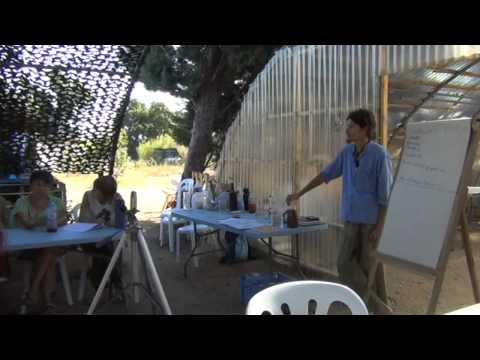
« oponopono » et qu'est ce qui nous fait avancer ?
« moi, personellement, je »
Vidéo thématique de vivre cru 7 -une « journée type »


Report
Block Member?
Please confirm you want to block this member.
Vous ne pourrez plus le faire :
- See blocked member's posts
- Mention this member in posts
- Invite this member to groups
- Message this member
- Add this member as a connection
Please note: This action will also remove this member from your connections and send a report to the site admin. Veuillez patienter quelques minutes avant que cette procédure ne soit terminée.
Report
Nous utilisons des cookies pour mesurer l'audience et améliorer votre navigation. En savoir plus

Accédez à l'intégralité
des contenus RGNR
Lives Q&R hebdomadaires, parcours santé personnalisés, formations,
replays exclusifs, communauté de membres engagés…
Plus de 1 500 vidéos et programmes pour reprendre
le pouvoir sur votre santé.
0 commentaires
💬 Connectez-vous pour participer à la discussion
Se connecter →